Lightchain AI is a layer-1 blockchain built to run AI. People and programs pay a set fee in LCAI for each answer from an AI model, independent operators called workers serve those answers on their own graphics cards, and every answer is recorded as a job on the chain. The main network has been live since May 5, 2026.
This page explains how that works, which parts are live, which are in beta and which are still planned, and how to check each point on the public chain instead of taking anyone's word for it.
Lightchain AI in plain words
Most AI products run on one company's servers. That company picks the models, sets the prices, holds the accounts and decides who gets access.
Lightchain splits those jobs up. Open models, whose weights are published so anyone can run them, are served by workers: operators who stake LCAI and run the models on their own hardware. Users sign in with a crypto wallet instead of an email address and pay per answer. The fee for each model is a setting stored on the blockchain, and each answer leaves a public record of the worker that served it.
Lightchain is a layer 1, which means it is a base network of its own rather than an add-on to another chain. Its chain ID is 9200, and LCAI is its native coin.
What is live today
Statuses as of November 2026, taken from Lightchain's documentation:
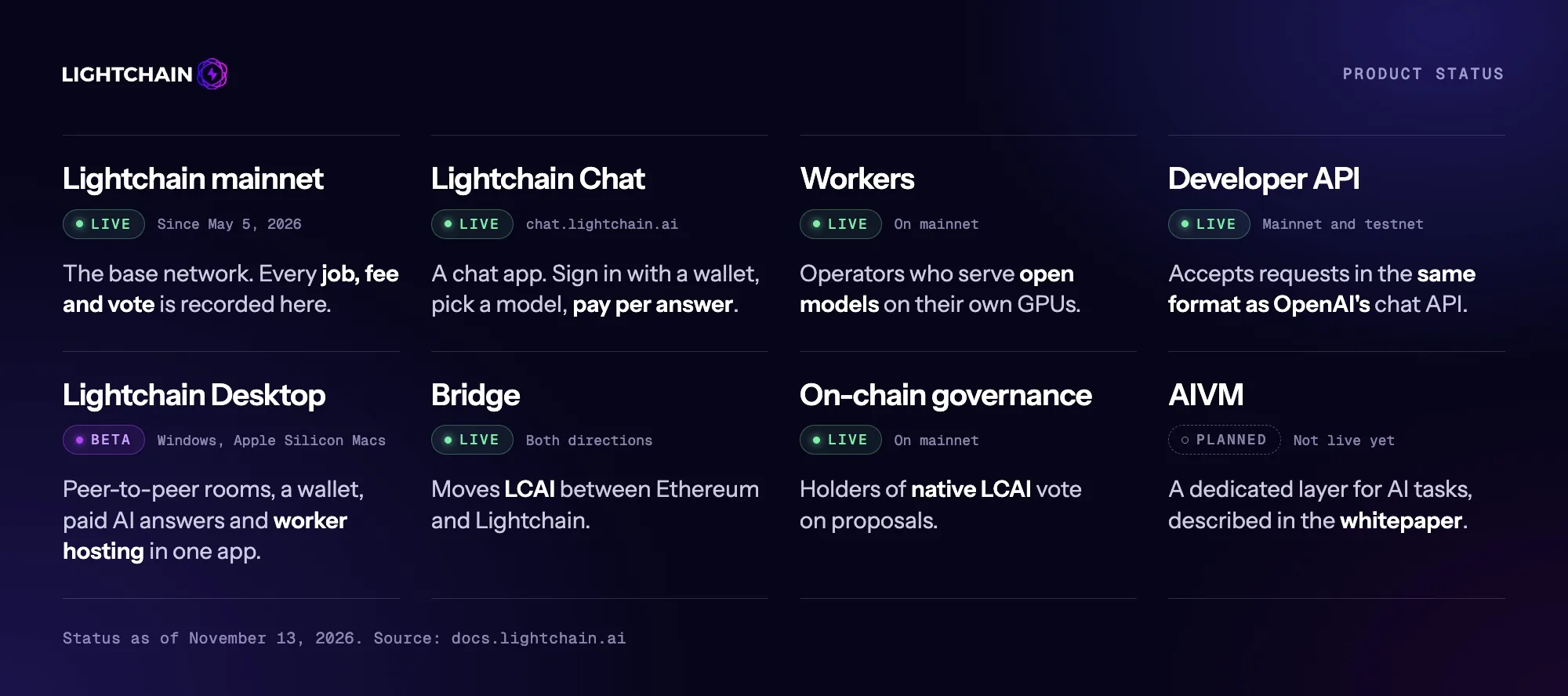
A dedicated layer for AI tasks described in the whitepaper. Not live yet.
How one answer moves through the network
Following a single question in Lightchain Chat shows how the pieces fit together.
A user signs in with a self-custody wallet, picks a model and sends a question.
The question becomes a job on the blockchain. Its fee is set by the model chosen, not by the length of the question.
The question travels encrypted, under a key that is created and kept in the user's browser.
The blockchain runs a weighted random draw among the workers able to serve that model, and the winner takes the session. Since October 2026 no central service hands out the work.
The worker runs the model on its own hardware, sends the answer back and commits the result on chain, with its address attached.
The fee is split on chain. At the network's launch settings, 80% goes to the worker, 15% to the treasury and 5% to a shared fee pool. If no worker answers, the user gets the fee back.
A checking service called the disputer re-runs a sample of jobs and compares the results. Answers that do not hold up are recorded against the worker that served them.
What LCAI is used for
LCAI has three uses on the network:
It pays for AI. Each model has one fee per answer. On the network's published list (October 21, 2026, subject to change), chat models run from 0.02 LCAI to 0.20 LCAI per answer. LCAI also pays the transaction fees on the chain.
It backs the work. A worker stakes 50,000 LCAI to serve models.
It carries a vote. Holders of native LCAI vote on proposals through on-chain governance.
LCAI also exists as a token on Ethereum. The bridge converts it into native LCAI, which is the form that pays for answers and counts in votes.
Who sets the rules
The settings that run the network, such as the fee for each model and the stake a worker must hold, live in smart contracts on the blockchain, where anyone can read them.
Since October 20, 2026, the protocol contracts have been owned by a multisig wallet that needs three of its five signers to approve a change.
The treasury is owned by a timelock. A governance proposal that passes waits 48 hours before it can be executed, so everyone can see a change before it takes effect.
The LCAI DUNA, a decentralized unincorporated nonprofit association formed under Wyoming law, is the network's legal association.
How to check Lightchain AI yourself
People searching for Lightchain AI often ask whether it is legit. The most useful answer is a list of things you can verify on your own, without trusting this page:
The chain itself. The mainnet explorer at mainnet.lightscan.app shows blocks, transactions and accounts as they happen.
The contracts. The contract addresses page lists every protocol contract, the models the network accepts and the fee for each one. Anyone can read the current owner of a contract on chain.
The workers. The worker explorer shows the operators serving models.
The votes. Proposals and results are public at dao.lightchain.ai.
One real answer. Ask a question in Lightchain Chat, then look up the job on the explorer and see which worker served it.
The audits. The documentation lists third-party audits of the LCAI ERC-20 token contract by Cyberscope, Solidproof and CertiK, and notes that more are pending. These cover the token contract, not the whole network.
One more check: Lightchain is no longer active on Telegram. Official updates come through its Discord and its X account, @LightchainAI. Messages from anywhere else claiming to speak for the project should be treated with caution.
What the on-chain record proves, and what it does not
Every answer on Lightchain is a paid job served by a named worker, and that record is public. It is not a mathematical proof that a specific model produced a specific sentence. Lightchain's documentation states this limit directly, and it is worth knowing before relying on the record for anything more.
Frequently asked questions
Is Lightchain AI a layer-1 blockchain?
Yes. Lightchain runs its own base network, with chain ID 9200 and LCAI as its native coin.
When did the Lightchain mainnet launch?
The main network went live on May 5, 2026.
Which AI models run on Lightchain?
The network accepts a set list of open models, including Llama 3, Gemma, gpt-oss, Qwen, DeepSeek R1, Mistral Small and GLM. The current list and the fee for each model are on the contract addresses page.
Do I need an account to use Lightchain Chat?
No. You sign in with a self-custody wallet holding native LCAI. An exchange account will not work.
Who can read my questions in Lightchain Chat?
Questions and answers travel encrypted under a key kept in your browser. A conversation can be read by you, the worker serving the session and the network's checking service. When you turn on web search, the question is also sent to a search provider.
Try it
Lightchain Chat, in public beta, is open to anyone with a self-custody wallet at chat.lightchain.ai. Ask one question, then find its job on the explorer.
This article is for informational purposes only and is not financial advice.

 Kleanthi